Every fencer, parent, and coach has debated it: which attack is better, the traditional lunge or the dynamic flèche? Researchers brought in six world-leading female épée fencers from the Polish national team — including four World Championship medalists — and used EMG sensors, force plates, and motion capture to find out. The answer is clear: the flèche is significantly faster and more explosive than the lunge.
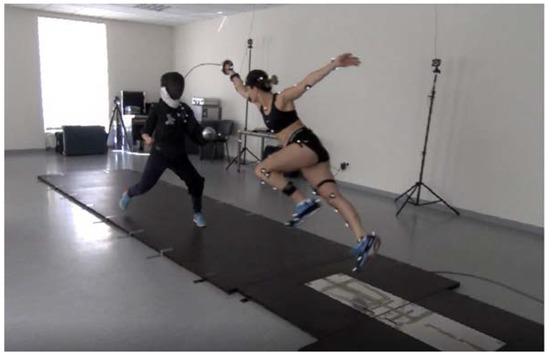

Photos: Borysiuk et al., Int. J. Environ. Res. Public Health 2019, 16(13), 2315. Performed by World Champion Danuta Dmowska (published with consent). CC BY 4.0.
The Science Behind the Strip
The researchers used three measurement systems simultaneously on each attack:
- EMG (electromyography): Electrodes on 8 muscles measuring exactly when and how hard each muscle fires.
- Force plates: Two Kistler plates under the fencers' feet measuring the vertical and horizontal force generated by each leg.
- Motion capture: An OptiTrack system with eight cameras at 100 FPS tracking body position throughout the attack.
After warming up, each fencer performed six total attempts — three flèches and three lunges — toward the coach's target, mimicking competition conditions. The results were clear.
The Flèche: 58 Milliseconds Faster
The standout finding: while reaction times were nearly identical (175 ms for the flèche, 173 ms for the lunge), the flèche's movement time was significantly shorter — 510 ms vs 568 ms (p = 0.046).
Your brain processes both attacks the same way. The measured difference came from movement time rather than reaction time.
Much Higher Calf Muscle Activation
EMG analysis revealed substantially higher gastrocnemius activity during the flèche in the rear leg:
- Gastrocnemius lateralis (the outer calf muscle): 146 μV during flèche vs 73.1 μV during lunge — nearly 2× the activation (p = 0.027)
- Gastrocnemius medialis (the inner calf muscle): 207.7 μV vs 94.7 μV — more than 2× the activation (p = 0.027)
The flèche produced substantially higher gastrocnemius EMG activity, alongside significantly greater rear-leg vertical ground reaction force: 142.8 N vs 115.9 N (p = 0.028).
Two Different Coordination Sequences
Perhaps the most interesting finding was how differently the legs coordinate during each attack:
- The lunge: Starts with the rear leg pushing off. The front foot lands before the touch is made. The sequence is rear-leg-push → front-foot-land → touch.
- The flèche: Both legs fire simultaneously with a powerful forward drive. The touch is made before the rear leg leaves the ground — it acts as support to prevent falling (which would be a penalty). The sequence is both-legs-drive → touch → rear-leg-lifts.
Can Your Opponent Read Which Attack Is Coming?
The researchers noted an intriguing tactical implication: because the flèche and lunge start with different leg activation patterns, an experienced opponent might detect "preliminary signals originating from the lower limbs" and anticipate which attack is coming. This means disguising the initial leg movement could be just as important as the attack itself.
A Brief History
The flèche wasn't always part of fencing. At the first modern Olympics in Athens in 1896, footwork consisted of steps, leaps, and lunges. It wasn't until the 1930s that Hungarian fencers introduced the flèche as an innovative, dynamic alternative — and it has been reshaping épée tactics ever since.
What This Means for Your Training
- Train your calves for the flèche specifically. The calf muscles (gastrocnemius lateralis and medialis) showed roughly twice the EMG activation during the flèche compared to the lunge in this study. Calf raises, plyometrics, and explosive push-off drills may help build the foundation for a faster flèche.
- Focus on movement time, not reaction time. Both attacks had identical reaction times. The speed advantage comes from how efficiently your body executes after the decision is made. Drill the explosive push-off until it's automatic.
- Disguise your initial leg movement. If opponents can read which attack is coming from your lower body, practice making your flèche and lunge setups look identical for as long as possible.